About Us
We are a research group led by Professor Yu Feng. The group started at UC Santa Barbara and now has members at UCLA and UC San Diego as well. We build automated reasoning tools at the intersection of programming languages, formal verification, and security, rooted in program synthesis, type theory, and constraint solving. A unifying theme is combining logical reasoning with learning to push the frontier of what automated tools can guarantee.



Current Work
- Formal methods and security for AI agents, ensuring autonomous systems behave safely and correctly through verification and runtime guarantees.
- Compilers and verifiers for zero-knowledge proof circuits, with tools such as Tabby and Tessel that detect vulnerabilities and optimize performance in ZK systems deployed in production.
- Smart contract and DeFi security, including attack synthesis and state-inconsistency detection.
- Synthesis-driven tools for end-user programming, such as data visualization and code transpilation.
News
- Automated Safety Analysis for Agentic Workflows accepted to ICSE 2027.
- Revealing Semantic Gaps in Zero-Knowledge Virtual Machines via Obligation-Targeted Semantic Fuzzing accepted to NDSS 2027.
- Junrui Liu joins Cal Poly as an Assistant Professor of Computer Science. Congratulations!
- Thunderbolt: Fast Asynchronous Off-Chain Bitcoin Transfers accepted to CCS 2026.
- Tabby, a synthesis-aided compiler for high-performance zero-knowledge proof circuits, appears at OOPSLA 2025.
- Yanju Chen starts as a postdoctoral scholar at UC San Diego.
- Yu Feng receives an Ethereum Academic Award for the third year in a row.
- Two papers at CCS 2024: Foray and AuthSaber.
- Certifying Zero-Knowledge Circuits with Refinement Types appears at IEEE S&P 2024, and ZKAP at USENIX Security 2024.
- Refinement Types for Visualization appears at ASE 2024.
- Two papers at PLDI 2023: Picus and conflict-driven synthesis for layout engines.
- Yanju Chen completes the Ph.D. with the thesis Deduction-Powered Neural Program Synthesis: A Synergistic Perspective.
- Visualization Question Answering Using Introspective Program Synthesis wins a Distinguished Paper Award at PLDI 2022.
- SolType appears at POPL 2022, Sailfish at IEEE S&P 2022, and Hecate at ASPLOS 2022.
- Falx wins a Best Paper Award at CHI 2021.
- Yu Feng receives a Google Faculty Research Award.
- Summary-Based Symbolic Evaluation for Smart Contracts wins a Distinguished Paper Award at ASE 2020.
People
Faculty
 Yu FengAssociate ProfessorUC Santa Barbara
 Yuan TianAssociate ProfessorUCLA
 Yufei DingAssociate ProfessorUC San Diego
Postdocs
 Yanju Chen
Ph.D. Students
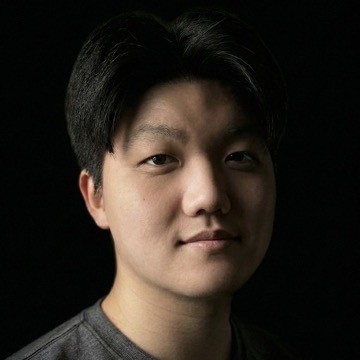 Hanzhi Liu
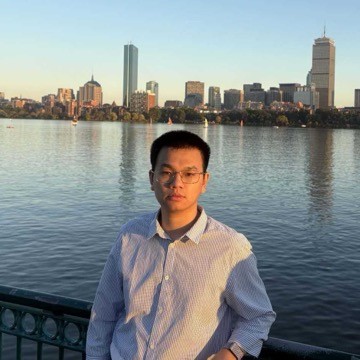 Hongbo Wen
 Ying Li
Alumni
 Junrui Liu
 Chaofan Shou
 Bryan Tan
Featured Publications
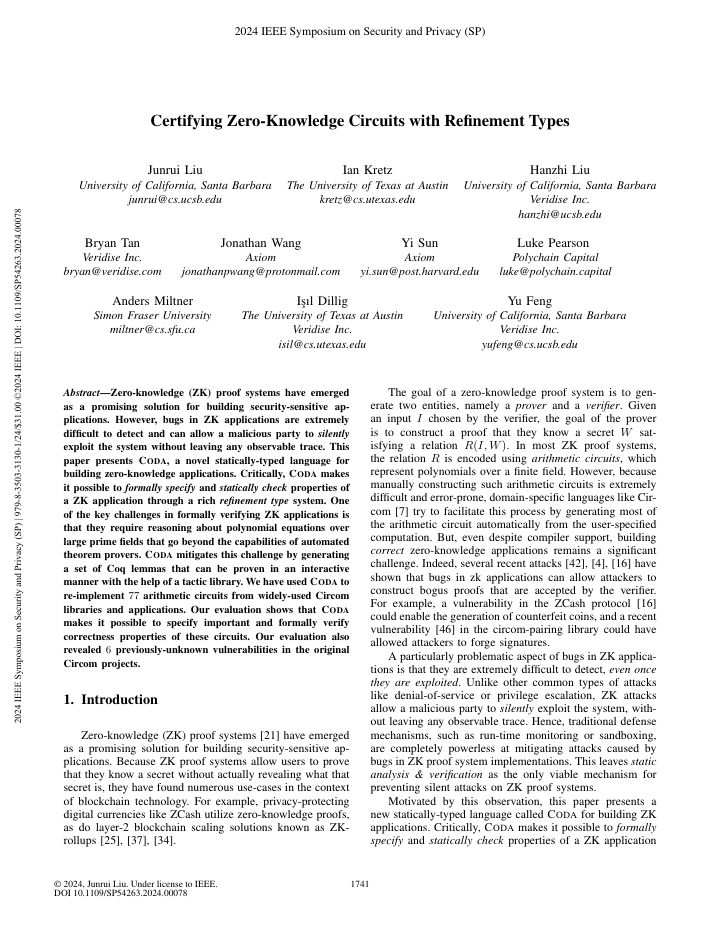
- Certifying Zero-Knowledge Circuits with Refinement Types IEEE S&P 2024
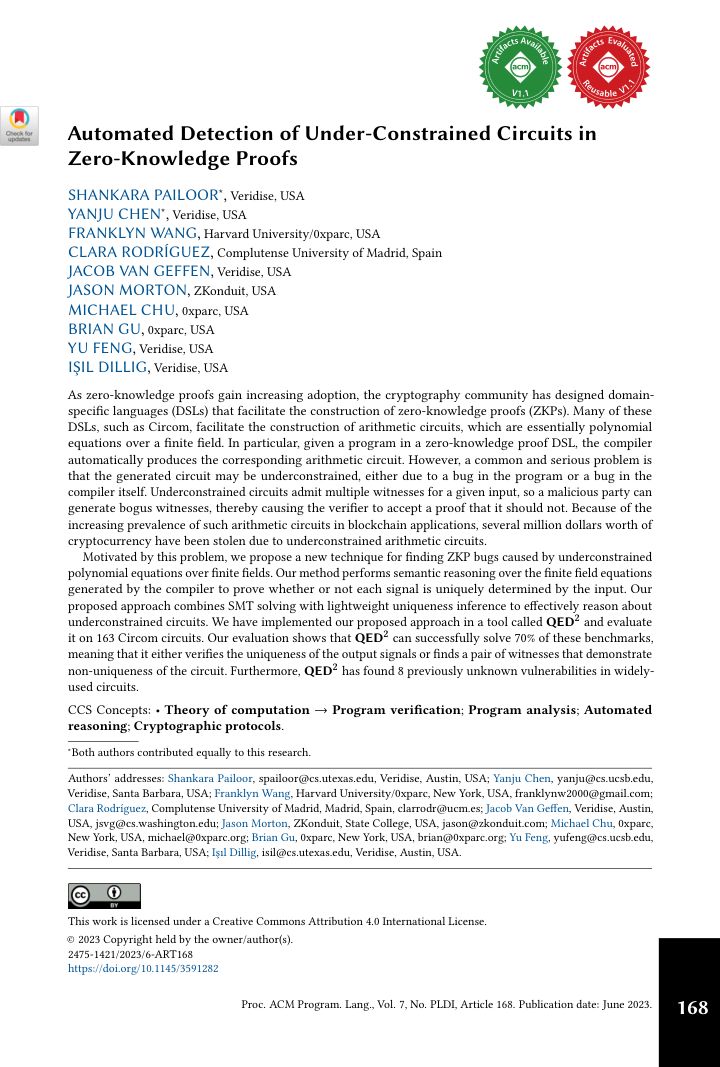
- Automated Detection of Under-Constrained Circuits in Zero-Knowledge Proofs PLDI 2023
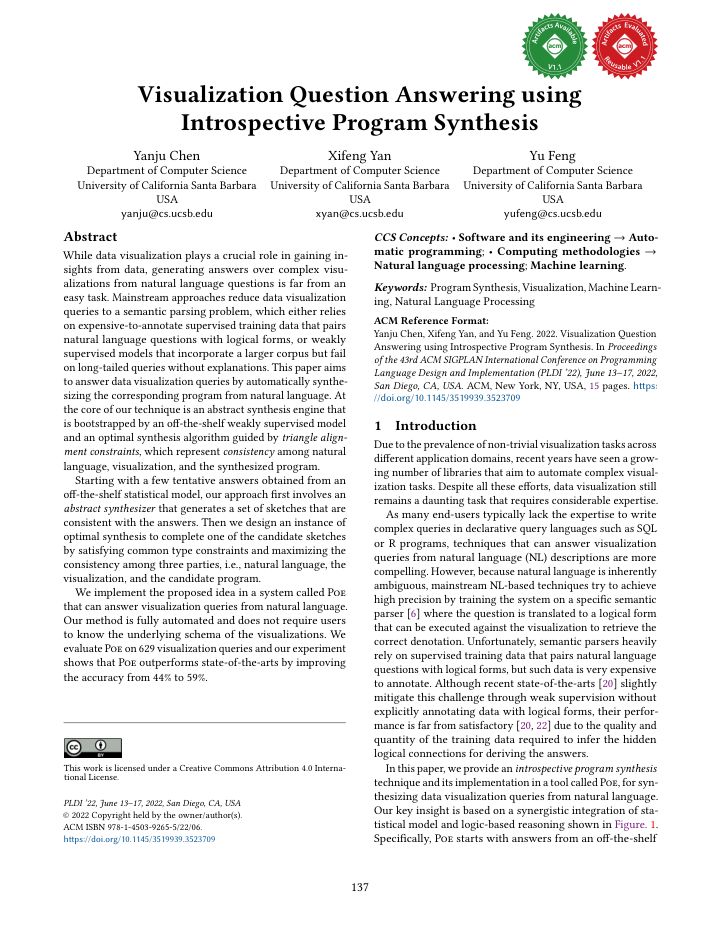
- Visualization Question Answering Using Introspective Program Synthesis PLDI 2022 Distinguished Paper
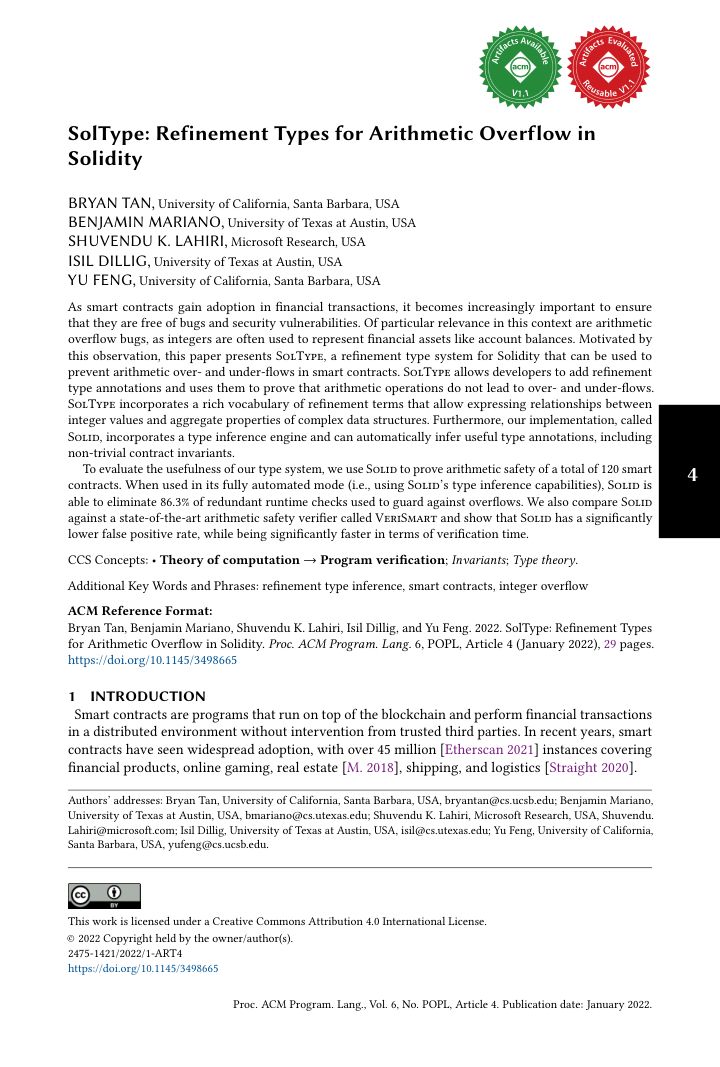
- SolType: Refinement Types for Arithmetic Overflow in Solidity POPL 2022
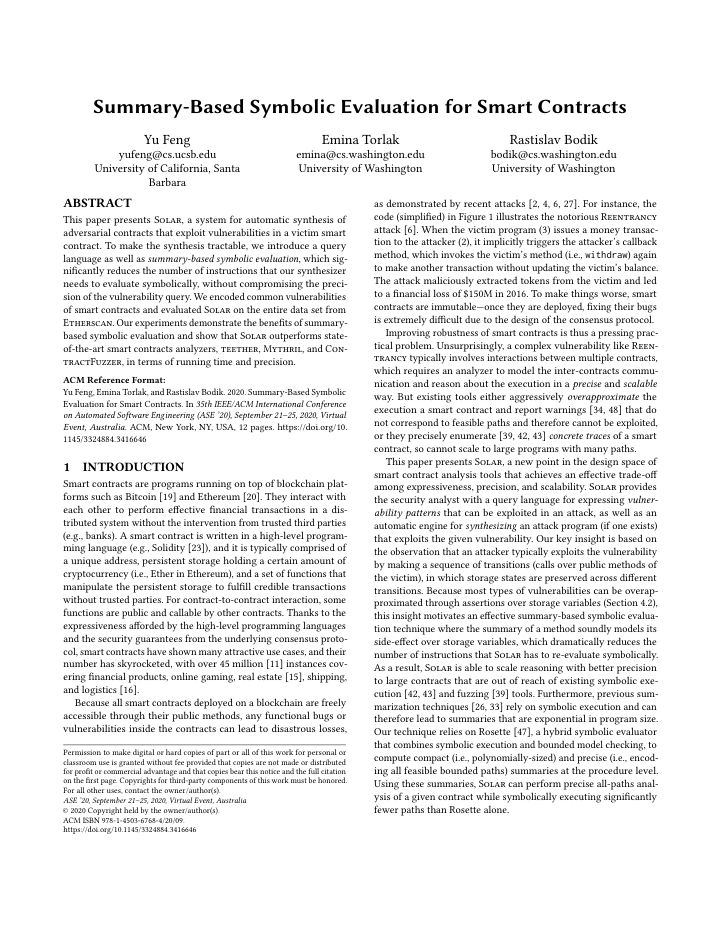
- Summary-Based Symbolic Evaluation for Smart Contracts ASE 2020 Distinguished Paper
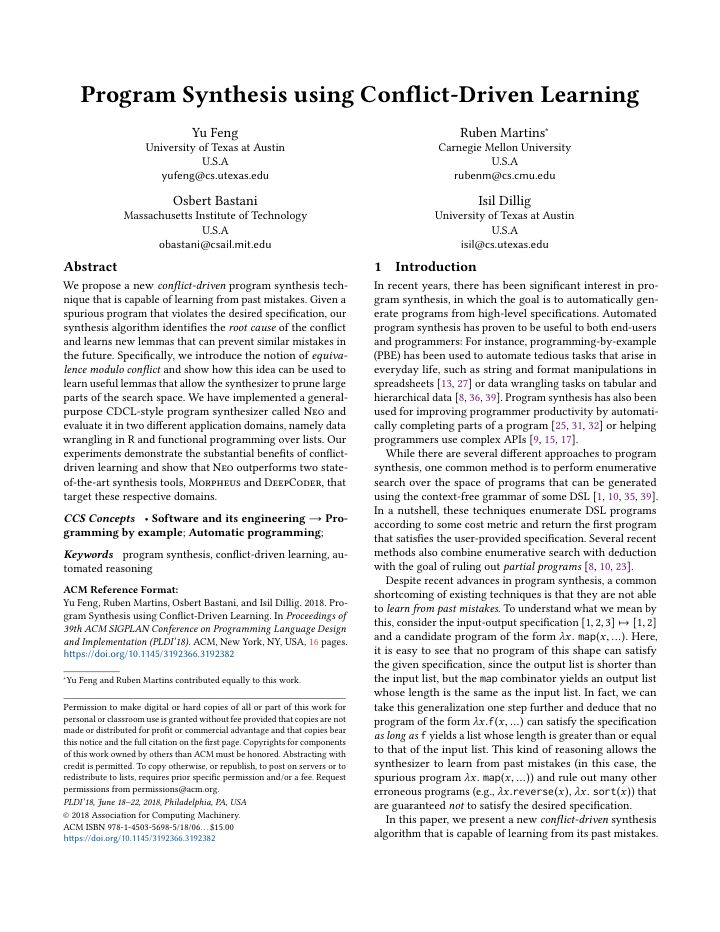
- Program Synthesis using Conflict-Driven Learning PLDI 2018 Distinguished Paper
All publications
- Automated Safety Analysis for Agentic WorkflowsICSE 2027
- Interpretable Security Analysis of Agent SkillsICSE 2027
- Revealing Semantic Gaps in Zero-Knowledge Virtual Machines via Obligation-Targeted Semantic FuzzingNDSS 2027
- Thunderbolt: Fast Asynchronous Off-Chain Bitcoin TransfersCCS 2026
- Tabby: A Synthesis-Aided Compiler for High-Performance Zero-Knowledge Proof CircuitsOOPSLA 2025
- Automated Repair of OpenID Connect ProgramsASE 2025
- Tessel: An Optimizing Compiler for Efficient Zero-Knowledge CircuitsSBC 2025
- FORAY: Towards Effective Attack Synthesis against Deep Logical Vulnerabilities in DeFi ProtocolsCCS 2024
- AuthSaber: Automated Safety Verification of OpenID Connect ProgramsCCS 2024
- Refinement Types for VisualizationASE 2024
- Certifying Zero-Knowledge Circuits with Refinement TypesIEEE S&P 2024
- Practical Security Analysis of Zero-Knowledge Proof CircuitsUSENIX Security 2024
- Fast and Reliable Program Synthesis via User InteractionASE 2023
- Conflict-Driven Synthesis for Layout EnginesPLDI 2023
- Automated Detection of Under-Constrained Circuits in Zero-Knowledge ProofsPLDI 2023
- Learning Contract Invariants Using Reinforcement LearningASE 2022
- Cerberus: Query-driven Scalable Security Checking for OAuth Service Provider ImplementationsCCS 2022
- Visualization Question Answering Using Introspective Program SynthesisPLDI 2022 Distinguished Paper
- Tree Traversal Synthesis Using Domain-Specific Symbolic CompilationASPLOS 2022
- SolType: Refinement Types for Arithmetic Overflow in SolidityPOPL 2022
- Automated Transpilation of Imperative to Functional Code using Neural-Guided Program SynthesisOOPSLA 2022
- Synthesis-Powered Optimization of Smart Contracts via Data Type RefactoringOOPSLA 2022
- SAILFISH: Vetting Smart Contract State-Inconsistency Bugs in SecondsIEEE S&P 2022
- Checking Conformance of Applications against GUI PoliciesFSE 2021
- Falx: Synthesis-Powered Visualization AuthoringCHI 2021 Best Paper
- Summary-Based Symbolic Evaluation for Smart ContractsASE 2020 Distinguished Paper
- Demystifying Loops in Smart ContractsASE 2020
- Program Synthesis using Deduction-Guided Reinforcement LearningCAV 2020
- Visualization by ExamplePOPL 2020
- OAuthLint: An Empirical Study on OAuth Bugs in Android ApplicationsASE 2019
- Maximal Multi-layer Specification SynthesisFSE 2019
- Relational Verification using Reinforcement LearningOOPSLA 2019
- Trinity: An Extensible Synthesis Framework for Data SciencePVLDB 2019
- Program Synthesis using Conflict-Driven LearningPLDI 2018 Distinguished Paper
- Singularity: Pattern Fuzzing for Worst Case ComplexityFSE 2018
- Precise Detection of Side-Channel Vulnerabilities using Quantitative Cartesian Hoare LogicCCS 2017
- Component-based Synthesis of Table Consolidation and Transformation Tasks from ExamplesPLDI 2017
- Automated Synthesis of Semantic Malware Signatures using Maximum SatisfiabilityNDSS 2017
- Component-Based Synthesis for Complex APIsPOPL 2017
- Hunter: Next-Generation Code Reuse for JavaFSE 2016
- Bottom-up Context-Sensitive Pointer Analysis for JavaAPLAS 2015
- EXPLORER: Query- and Demand-Driven Exploration of Interprocedural Control Flow PropertiesOOPSLA 2015
- Apposcopy: Semantics-Based Detection of Android Malware through Static AnalysisFSE 2014